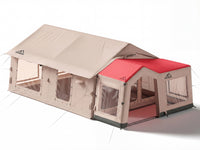
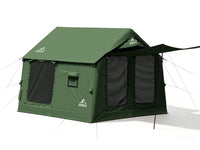
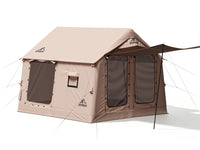
For many campers, the hardest part of camping is not always sleeping outdoors. It often starts with the first step after arriving at the campsite: setting up the tent.
Especially for weekend trips, car camping, couples’ getaways, or first-time campers, people have usually already spent time driving, unloading gear, and finding the right campsite. If they still need to spend a long time sorting poles, threading them through the tent, securing the fabric, and adjusting guylines, a relaxing outdoor trip can start to feel stressful from the very beginning.
That is why inflatable tents have become increasingly popular in recent years. Compared with regular tents, their biggest appeal is not how different they look, but how quickly they can be set up with an air beam structure, helping campers finish setup faster and spend more time enjoying the real camping experience.
So, compared with a regular tent, is a 3-minute setup really worth it?
🏕️ What Is an Inflatable Tent?
An inflatable tent uses an air beam structure to replace traditional tent poles. During setup, users do not need to connect poles one by one. Instead, they use a pump to inflate the air beams, allowing the tent body to gradually take shape.
This structure is very beginner-friendly. It reduces the parts of a regular tent setup that are most likely to go wrong, such as placing poles in the wrong direction, struggling to thread poles, failing to raise the structure, or finding it difficult to complete the setup alone.
For campers who want a more relaxing camping process, the advantage of inflatable air tents is that they lower the setup barrier. They are better suited for car camping, couples’ camping, easy weekend trips, and glamping scenarios that focus more on comfort.
🏕️ What Is a Regular Tent?
A regular tent refers to a traditional pole-supported tent, usually using aluminum, fiberglass, or steel poles to support the tent structure. Users need to sort the poles first, then thread, connect, raise, and secure them according to the tent structure, before finally adjusting the rainfly, stakes, and guylines.
Regular tents are not bad. Their advantages include a wide range of types, broad price options, and many weight choices. Different users can choose different styles based on hiking, backpacking, car camping, or regular campground camping.
However, for beginners, couples, and campers who do not want to spend too much time on setup, the setup process of a regular tent can indeed feel more stressful. Especially when it gets dark, the weather changes, or only one person is responsible for setting up the tent, the steps of setting up a traditional tent can feel more complicated.
⏱️ Setup Time: The Biggest Difference Between the Two Tent Types
Setup time is the most obvious difference between an inflatable tent and a regular tent.
The setup process for a traditional tent usually includes unfolding the tent body, sorting the poles, checking the structure direction, threading or clipping the poles, raising the tent, securing the rainfly, staking it down, and tightening the guylines. Experienced campers can certainly do this quickly, but for beginners, this process often requires more time and patience.
The process for an inflatable tent is more direct. Usually, you only need to unfold the tent, connect the pump, inflate the air beams, and then secure the stakes and guylines. Take Zonkoo Lyra as an example. It is an entry-level inflatable tent designed for 1–2 people, with about 65 sq ft of space, and it can be set up in about 3 minutes.
The meaning of this type of design is not just “speed.” More importantly, it allows campers to spend less energy dealing with the tent structure after arriving at the campsite. For weekend camping, this sense of ease can directly affect the entire trip experience.
🌄 Is a 3-Minute Setup Really Useful at the Campsite?
The value of a 3-minute setup is not just about saving a few minutes. It truly changes the way camping starts. Whether you leave in the afternoon and arrive at the campsite in the evening, or it is your first camping trip and you need to handle the groundsheet, sleeping bags, lighting, tables, chairs, and food at the same time, the faster the tent is set up, the smoother the entire campsite rhythm becomes.
If sudden wind or light rain comes in, setting up the tent quickly can also feel more reassuring. Traditional tents can still be used when the weather changes, but the setup process requires more experience and patience. For beginners or short weekend camping trips, a quick setup can clearly reduce the pressure at the beginning of the camping experience.
🛏️ Space and Comfort: A Tent Is Not Just for Sleeping
A tent is not just for sleeping. For car camping, couples’ camping, and short weekend camping trips, the interior space also needs to fit sleeping pads, air mattresses, backpacks, clothes, small camping gear, and still leave some room to move around.
Many inflatable camping tents place more emphasis on interior comfort, such as standing height, ventilation, space efficiency, and real-use experience. Compared with some low-profile or compact traditional tents, inflatable tents are often better suited for users who want to stay longer at the campsite and care more about comfort.
Zonkoo Lyra has an interior height of 6'10", uses a center-pole-free design, and offers about 65 sq ft of living space. For 1–2 person couples’ camping, comfortable solo camping, or beginner weekend camping, this kind of space is more meaningful than simply “fitting people inside.”
🌧️ Wind and Rain Protection: Are Inflatable Tents Stable Enough?
Many people have one concern when they first learn about inflatable tents: without traditional tent poles, will they be stable enough?
In fact, whether a tent is stable does not depend only on whether it uses an inflatable structure or a pole-supported structure. What truly affects outdoor performance is the strength of the air beams, tent fabric, waterproof coating, seam treatment, stake fixation, guyline system, and whether the tent is set up correctly.
Take Lyra as an example. It uses a PU5000 mm waterproof rating and comes with fully taped seams to improve rain protection. At the same time, it also uses a reinforced guyline system, which can handle winds up to about 50 MPH when set up properly.
Of course, this does not mean any tent is suitable for extreme weather. Whether it is an inflatable tent or a regular tent, you still need to choose a suitable campsite, avoid overly exposed windy areas, and properly secure the stakes and guylines. The tent’s own specifications are important, but correct use is just as important.
🧩 Durability and Daily Maintenance
Traditional tents and inflatable tents each have their own points to pay attention to.
Common issues with a regular tent may include bent poles, broken poles, damaged connectors, worn rainfly fabric, or aging seams. An inflatable tent requires more attention to the air beams, valves, pressure changes, and avoiding sharp objects that may scratch the air columns or the tent body.
This does not mean traditional tents are always more durable, nor does it mean inflatable tents are always easy to damage. What truly determines service life is still the materials, structure, workmanship, and daily maintenance.
Lyra uses 210D Oxford fabric with PU coating for the tent body, 420D Oxford fabric for the floor, and PVC-coated mesh fabric for the air columns. These materials are more suited for everyday camping, couples’ trips, and easy weekend camping, rather than extreme expeditions or professional alpine environments.
In daily use, try to keep the tent dry before storage and avoid storing it while damp for a long time. Do not drag it over sharp rocks or branches during setup. Before packing it away, check the valves, seams, stakes, and guylines. Doing these things helps the tent maintain more stable performance.
🎒 Weight and Packing: Which Tent Is Easier to Carry?
In terms of weight and packing, a regular tent still has its own advantages.
If you often go backpacking, hiking, or need to carry your gear for a long distance, a lightweight traditional tent is usually more suitable. Because many inflatable tents are designed to improve space, comfort, and air beam structure, their overall weight is often higher than that of ultralight tents.
Lyra weighs 29 lbs and packs down to 23" × 14" × 16". These weights and packed sizes are better suited for car camping, short-distance carrying, and campground camping, rather than long-distance backpacking.
So when choosing a tent, you should not only look at setup speed. You also need to consider your camping style. If you mainly drive to the campsite and only need to carry the tent a short distance after parking, the weight of an inflatable tent is usually acceptable. If you need to backpack into the mountains, a regular lightweight tent may still be the more reasonable choice.
👥 Who Is Better Suited for an Inflatable Tent?
If your camping style is mainly couples’ camping, comfortable solo camping, car camping, or weekend campground camping, then an inflatable tent is a choice worth considering.
It is better suited for people who want to reduce setup pressure. Especially for beginners, there are often many things to handle when arriving at the campsite for the first time. If the tent can take shape faster, the whole camping process becomes easier to settle into.
For 1–2 person camping, an entry-level inflatable tent like Lyra is also a good option for trying an inflatable tent for the first time. It does not require a complicated pole structure, while still balancing standing height, basic waterproof protection, interior comfort, and portability.
For larger family camping, you can choose a larger inflatable tent based on the number of people and the amount of gear, instead of only looking at setup speed. Whether a tent is suitable ultimately comes back to people, space, weight, and usage scenarios.
👥 Who Might Be Better Suited for a Regular Tent?
A regular tent is better suited for users who care a lot about lightweight gear, budget control, or often go backpacking and long-distance hiking.
If your camping style is more minimal, lightweight, and fast-moving, or if every pound of weight needs to be carefully considered, then a lightweight traditional tent is still very practical. It offers a wide range of choices and makes it easier to find styles designed specifically for hiking, mountaineering, or minimalist camping.
For experienced campers, setting up a regular tent is not necessarily a burden. Some users even prefer the structural control and familiar setup process that traditional tents provide.
✅ Is a 3-Minute Setup Really Worth It?
For car camping, couples’ camping, and beginner camping, a 3-minute setup is worth it.
It is not just about saving a few minutes. It also reduces the sense of confusion after arriving at the campsite. The easier a tent is to set up, the easier it is for campers to focus on what truly matters, such as organizing the campsite, preparing dinner, setting up the sleeping area, or simply enjoying the outdoors.
A regular tent still has its own advantages, especially for lightweight travel, lower budgets, and long-distance hiking. But if your goal is to make camping easier, more comfortable, and better suited for weekend use, then the quick setup experience of an inflatable tent is not just a selling point. It is a very practical upgrade.
For users who want to switch from a traditional tent to a more convenient option, an entry-level inflatable tent like Zonkoo Lyra can be a very natural starting point, with setup in about 3 minutes, 1–2 person capacity, 65 sq ft of space, and PU5000 mm waterproof performance.
🛒 Want to Make Your Next Camping Trip Easier and More Comfortable?
If you are planning weekend camping, a couple’s trip, or a relaxing outdoor getaway, an inflatable tent can make campsite setup faster and the entire camping experience more calm and comfortable.