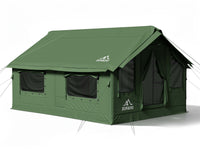
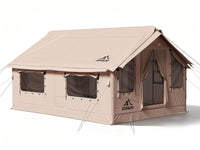
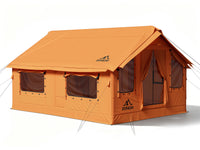
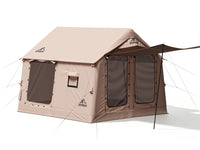
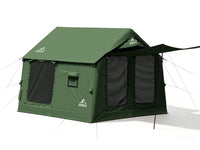
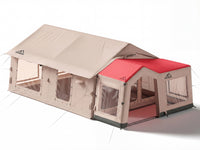
Once children come along, a tent quickly becomes more than a place to sleep. Beyond sleeping pads, families need room for extra clothes, toys, storage bins, kids’ chairs, and rain gear. Parents may still need to organize supplies after the children have gone to bed, and a change in weather can leave everyone spending more time inside. How well the tent handles those situations can shape the entire camping experience.
The Zempire Evo TM V2 and ZONKOO Vega both sleep up to six people and offer nearly identical floor space: 130 sq. ft. in the Evo TM V2 and 129 sq. ft. in the Vega. That 1-square-foot difference means little on its own. Once the beds and children’s gear are in place, however, the two tents organize family life in noticeably different ways.
The more useful comparison is how each tent handles family sleeping arrangements, shared activities, gear storage, and everyday entry and exit, along with the effect its design has on setup, transport, and multi-day use.
Tent Specifications at a Glance
|
Feature |
Zempire Evo TM V2 |
ZONKOO Vega |
|
Capacity |
Comfortable for 4; sleeps up to 6 |
2–6 people |
|
Total Area |
12.1 m² / 130 sq. ft. |
12 m² / 129 sq. ft. |
|
Height |
82.7 in. peak height |
90.6 in. exterior height; 85 in. interior height |
|
Doors and Windows |
2 entrances, a PVC skylight, a side window, and a rear ventilation window |
Dual entrances, 2 skylights, 3 side windows, and 2 door-side windows |
|
Inflation / Setup Time |
3-minute inflation |
11-minute setup |
|
Weight |
53 lb. 6 oz. |
117 lb. |
|
Packed Size |
27.6 × 18.1 × 18.1 in. |
30 × 21 × 22 in. |
|
Tent Fabric |
150D Poly-Oxford |
420D Oxford fabric with PU coating |
|
Floor Material |
14 × 14, 180 gsm PE |
PVC-coated mesh fabric |
|
Air Beam Material |
Tri-Wrap Air Tubes |
PVC-coated mesh fabric |
|
Waterproof Rating |
6,000 mm |
PU5000 mm |
|
Current Price |
$1,200 |
$1,299.99 |
Family Space and Sleeping Arrangements
The two tents differ in floor area by only 1 sq. ft., and both include dividers that can separate the parents’ and children’s sleeping spaces. The real difference is what happens to the rest of the interior once those areas are divided.
The Evo TM V2 places the sleeping area at the rear, with a living area and extended awning at the front. Closing the divider gives parents and children separate sleeping spaces, while chairs, storage bins, and frequently used items can remain in the living area instead of crowding the beds. With fewer campers, opening the divider creates a larger, more open sleeping area.
The Vega can also divide the interior for family sleeping arrangements. Its 129 sq. ft. interior has no center pole, so beds and furniture can be positioned with fewer restrictions. During the day, families can open the divider and rearrange the space for sleeping, storage, or activities. The layout can also change as children grow or the number of beds changes.
The Evo TM V2 has a more clearly defined layout for families that prefer each area to serve a set purpose. The Vega leaves more room to adjust furniture and activity space as family needs change.

Kids’ Gear and Rainy-Day Use
Beds are only part of what fills a family tent. Toys, clothing, shoes, rain gear, and storage bins can quickly take over the remaining space, and wet weather may force even more of those items inside.
In the Evo TM V2, dry supplies can stay in the living area. The front awning provides a place to change shoes and temporarily sort rain gear before entering, while keeping some wet items away from the sleeping area. During wind-driven rain, families may still need to move gear depending on the direction of the opening and the weather.
The Vega does not have a separate awning extending beyond the tent, but its interior forms a more continuous space. Beds can go on one side, with children’s chairs, toys, and storage bins on the other. When the family needs to stay inside longer, some items can be moved to make room for children to sit or walk around. The 85-inch interior height also makes it easier for parents to stand while arranging bedding and clothing.
The Evo TM V2 offers a convenient way to keep some wet gear apart from sleeping items. The Vega makes it easier to reorganize the interior when the weather changes.
Entry, Exit, and Ventilation
When several family members are coming and going, shoes, backpacks, and children’s gear can quickly collect around the entrance. Both tents have two entrances, but they manage foot traffic in different ways.
The Evo TM V2 connects its entrances to the living area and front awning. Parents can deal with shoes and gear under the awning before moving farther inside. Its PVC skylight, side window, and rear ventilation window are positioned around the tent, allowing families to adjust airflow in the sleeping and living areas as conditions change.
The Vega also has dual entrances, along with 2 skylights, 3 side windows, and 2 door-side windows. Families can use whichever entrance works best with the placement of beds and storage, rather than sending everyone through the same path. The multiple openings also bring in more daylight and allow airflow to be adjusted based on the wind and sun while children are inside.
The Evo TM V2 has a peak height of 82.7 inches, while the Vega has an interior height of 85 inches. Adults can stand in both tents, but the Vega’s center-pole-free design makes more of its taller interior usable.
Setup and Transport
After reaching the campsite, parents still need to watch the children, unload the vehicle, and set up the beds. In that situation, the effort required to move the tent to the site and complete every setup step matters more than comparing two time figures by themselves.
The Evo TM V2’s air beams can be inflated in 3 minutes, but that figure does not include unfolding the tent, adjusting its structure, or securing the stakes and guy lines. The Vega’s stated 11 minutes covers the full setup process, so the two numbers cannot be directly compared to determine which tent will be ready sooner.
The Evo TM V2 weighs 53 lb. 6 oz. Its single packed bag is easier to move than the 117-pound Vega, although some parents may still find it heavy. When the parking area is far from the campsite, families should consider whether one adult can carry it alone.
At 117 pounds, the Vega is more practical when the vehicle can be parked close to the site, and moving it is easier with two adults. Once it is set up, the family has continued access to the full 129 sq. ft. interior throughout the stay.
The Evo TM V2 places less strain on families that change campsites frequently and need to load and unload the tent several times. For a stay of several days in one location, the Vega’s heavier transport demands are mostly limited to arrival and departure.
Fabric and Waterproof Performance
In a family tent, the floor has to handle more than people walking across it. Toys, storage bins, chairs, and muddy shoes all create repeated contact. Pets can add scratching, movement, and chewing, so the difference between 150D and 420D fabric does not tell the whole story.
The Evo TM V2 uses a 150D Poly-Oxford tent body, a 180 gsm PE floor, and Tri-Wrap Air Tubes, with a waterproof rating of 6,000 mm. The materials protect family camping while helping keep the overall weight more manageable for transport, but scratch and bite resistance are not emphasized features.
The Vega uses PU-coated 420D Oxford fabric, with PVC-coated mesh fabric for the floor and air beams. It carries a PU5000 mm waterproof rating. These materials are specifically designed to resist scratching and biting, providing more protection from pet claws, light chewing, toys being dragged across the floor, and friction from chairs. That can be especially useful for families with babies or pets spending time inside the tent.
The Vega’s heavier tent body, floor, and air beams contribute to its overall weight, but the added abrasion, scratch, and bite resistance is also part of the value of those materials. With either tent, actual wet-weather performance will still depend on campsite drainage, proper anchoring, and how the doors and windows are managed.

Price and Feature Value
The Evo TM V2 is priced at $1,200, while the Vega costs $1,299.99. A difference of less than $100 is not enough by itself to determine which tent offers better value. The better choice depends on which features a family expects to use most often.
The Evo TM V2 separates the interior into sleeping and living areas and adds a front awning, while keeping the weight lower and the packed size more compact. Parents can quickly decide where the beds, storage, and entry gear should go, and the lighter package reduces the effort involved in repeated loading and unloading.
The Vega offers 129 sq. ft. of interior space, an 85-inch standing height, a divider, dual entrances, and several windows and skylights. Its 420D tent body and PVC-coated floor and air beams add weight, but they also provide scratch and bite resistance. For families with babies or pets, those materials are better equipped for everyday wear from toys, furniture, pet movement, and light chewing.
The two tents are close in price. With the Evo TM V2, the value lies mainly in its clearly defined areas, front awning, and easier transport. With the Vega, the additional cost goes toward a more continuous and adjustable interior, greater standing height, and materials designed for households camping with children or pets.
Which Tent Is Better for Camping with Kids?
Both tents can work well for camping with kids, but they suit different travel styles and approaches to using interior space.
The Evo TM V2 is easier to manage for families who take frequent weekend trips, load and unload the tent several times, or rely mainly on one adult to carry it. Its lower weight and clearly defined sleeping area, living area, and front awning make it easier to organize beds, supplies, and the entry area after arriving at camp.
The Vega is better suited to families that want the tent to serve as a living space for several days. Its taller, center-pole-free interior makes it easier to arrange beds, chairs, tables, and children’s gear, while the divider supports both separate sleeping arrangements and daytime activities. The 420D tent body, scratch-resistant floor, and air beams are also well suited to families with young children or pets, helping the tent withstand everyday wear from toys, furniture, and pet activity.
To see how the Vega compares with another inflatable tent for families of two to six, continue reading: RBM Panda Air Large vs. ZONKOO Vega: 2–6 Person Inflatable Tent Comparison.