A Clear Explanation of Condensation, Leaks, and the Most Commonly Misunderstood Truths in Small Tents
If you’ve ever woken up on a camping morning to find droplets of water on the inner walls of your tent, or noticed that the edge of your sleeping bag felt slightly damp, you’ve probably asked yourself this question: Did rain seep in overnight? Is the tent’s waterproofing not good enough?
In many real camping situations, this assumption isn’t actually accurate. The water you’re seeing is very likely not rain coming from outside, but a phenomenon that’s been misunderstood for a long time—tent condensation.
The goal of this article is to help you build a way of judging the situation that’s closer to real-world use: Why is condensation almost unavoidable? How is it different from actual leaks? And in small tents, what should we really be paying attention to?
What Is Condensation? Let’s Get This Clear First
Imagine a familiar situation: On a summer day, you take a cold drink out of the refrigerator. Before long, water droplets form on the outside of the bottle.
Tent condensation works on the same principle. When warm, humid air inside the tent (from breathing, body heat, light perspiration, and similar sources) comes into contact with a cooler tent surface, the moisture in the air condenses into water droplets that cling to the inner wall or the rainfly.
In other words, Condensation is not water that “leaks in” from outside, but moisture that already exists in the air, changing form.
Why Is There Almost No Such Thing as a “Completely Condensation-Free” Tent?

This is an easily overlooked fact that fundamentally shapes how the issue should be understood: Condensation is not a flaw of a specific brand or tent design—it’s an extremely common physical phenomenon in camping environments.
People themselves are a constant source of moisture
As long as you’re resting inside a tent, half of the conditions for condensation are already in place. Breathing, body heat, and light perspiration during sleep continuously release moisture into the tent. That moisture doesn’t simply disappear—it accumulates in the enclosed space.
Nighttime temperature drops are normal outdoors
Whether the night is clear or overcast, ambient temperatures almost always fall after sunset. The outer layers and inner walls of a tent naturally become cooler than the air inside, and materials or waterproof ratings can’t fully change this.
When warm, moist air meets a cooler surface, condensation occurs
Once the moisture in the air reaches saturation, it condenses on surfaces with lower temperatures. That’s why even tents with mature designs and high waterproof ratings cannot achieve “zero condensation.”

You may also notice that, in more compact tents, this process happens faster and is easier to see. Moisture concentrates more quickly, air exchange paths are shorter, and temperature differences between inside and outside are amplified. This isn’t a problem with the tent itself, but a natural result of overlapping physical conditions.
Why Are Condensation and Leaks So Often Confused?
In real-world use, condensation is most commonly mistaken for a leak, and the reason is actually quite simple:
They both look like water, and they often appear in the morning. But when you look more closely, there are clear differences in how they form and how they present.
Condensation typically appears as Water droplets or a thin film that clings to the inner walls of the tent, distributed relatively evenly. It often occurs when there’s a large temperature difference at night and insufficient ventilation. As the sun rises or ventilation improves, the droplets usually decrease or even disappear.
Leaks, on the other hand, are different. Leaks usually occur around the top of the tent, seams, or stress points, and are directly related to rainfall intensity. The water traces are more concentrated, directional, and continue to appear during the rain.
Understanding this difference allows for more accurate judgment of where moisture is actually coming from, rather than assuming that any water inside the tent means waterproofing failure. And because condensation is closely tied to moisture buildup and enclosed space conditions, it tends to be more noticeable in tents under 12㎡—not because there’s something wrong with the tent, but because condensation happens faster and in a more concentrated way.

Condensation Can’t Be Completely Avoided, but It Can Be Effectively Managed
Since condensation is a natural phenomenon, the more meaningful question becomes: Can a tent keep condensation within a range that doesn’t affect rest under real camping conditions?
In the design of ZONKOO tents, the focus has always been on how air enters, how it moves, and how it exits—rather than chasing the ideal of “zero condensation.”

An Efficient Ventilation Structure Is the Foundation
-
Large mesh panels: Provide continuous airflow while keeping insects out
-
Top ventilation vents: Help warm air rise and escape naturally
-
Cross-ventilation airflow paths: Allow air to move through the tent instead of entering and stagnating
-
Large door openings: Enable rapid overall air exchange during the day or when conditions allow
You can imagine a scenario like this: When a light breeze passes along the side of the tent, air enters through the side windows, flows through the interior, and then exits through the top vent or the opposite side. Moisture doesn’t linger in the sleeping area, and as a result, it’s less likely to build up to the point where condensation occurs.

In Small Tents, What Matters More Isn’t “Whether Condensation Exists”
For common small tents in the 8–12㎡ range, light condensation is not unusual. What truly deserves attention is whether condensation is kept away from contact areas, whether it’s isolated by a double-wall structure, and whether it affects sleep and storage experience.
This is why, when designing compact tents, ventilation paths, vent placement, and airflow efficiency are often more important than simply stacking higher waterproof ratings.
Common Questions About Tent Condensation
-
Does condensation affect a tent’s waterproof performance?
No. Condensation occurs inside the tent and has no direct relation to the rainfly’s waterproof coating or waterproof rating. Even when waterproof performance is fully intact, condensation can still occur.
-
Do double-wall tents eliminate condensation?
A double-wall structure cannot eliminate condensation, but it can effectively separate condensation from the usable space. Water droplets mostly form on the rainfly or the outside of the inner tent, significantly reducing their impact on rest.
-
Does heavy condensation mean poor tent quality?
Not necessarily. Condensation is closely related to temperature differences, ventilation conditions, and interior space, and it is not a single indicator of tent quality.
-
Can increasing waterproof ratings reduce condensation?
No. Waterproof performance and condensation are two separate issues, and increasing waterproof ratings does not reduce moisture condensation in the air.
What’s a More Realistic Standard When Choosing a Tent?
For most campers, “completely condensation-free” is not a realistic goal, nor should it be the sole criterion when choosing a tent.
What matters more is this: In typical camping environments, does the tent use well-designed ventilation and interior layout to keep condensation within a controllable range—one that doesn’t affect your rest, storage, or overall experience.

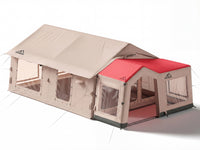
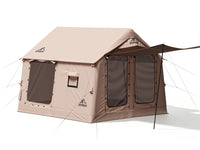
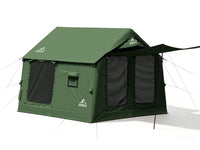
If you’re looking at tents in the 8–12㎡ range, or searching for models better suited to weekend camping or short family trips, feel free to explore the ZONKOO tent page🔍
There, you can see how different tent structures perform in real-world use, especially in terms of ventilation design and actual user experience, helping you make a choice that better fits your needs.