When people first see an inflatable tent, a natural question often comes to mind: if it relies on air for support, isn’t it basically like an air mattress?
It’s an understandable comparison. Many people have had the same experience with air mattresses: they feel firm right after inflation, but may soften over time and eventually need more air. If an air mattress can lose firmness, can a much larger tent—one that also needs to support the tent body and maintain its interior shape—really stay stable?
The key is that although inflatable tents also use sealed air, they are not designed to work like air mattresses. Their purpose, structure, and the role air plays within them are fundamentally different.
Are Inflatable Tents Basically Like Air Mattresses?
No.
Air mattresses and inflatable tents both seal air inside, but they are designed to do very different jobs.
An air mattress is primarily designed to provide cushioning and support while you sleep. When someone lies on it, the surface naturally compresses and changes shape under their weight. That flexibility is part of how it works. Its purpose is comfort, not maintaining a fixed structural shape like a frame.
An inflatable tent uses Air Beams for a different purpose.
Air Beams take on the role of the main support poles in a traditional tent. They support the tent fabric, maintain the tent’s shape, and create a stable interior space. Once inflated, the beams need to hold their intended shape and provide enough structural rigidity to support the tent rather than compressing noticeably like a sleeping surface.
So the main thing air mattresses and inflatable tents have in common is simple: both use sealed air.
In an air mattress, the air is mainly used for cushioning and support. In an Air Beam, it becomes part of the tent’s supporting structure.
For that reason, assuming an inflatable tent will collapse in the same way simply because an air mattress can soften over time is not an accurate comparison.

If Not an Air Mattress, What Is an Inflatable Tent More Like?
If the goal is simply to understand how this type of inflatable structure behaves, an inflatable SUP (stand-up paddleboard) is a better comparison.
An uninflated SUP is also soft and can be folded or rolled for storage. In that state, it can be hard to imagine it holding its shape, much less supporting the weight of an adult.
Once inflated to its intended pressure, however, it behaves very differently.
At the proper working pressure, a SUP can maintain its shape and become rigid enough for someone to stand on.
This illustrates a simple but important point:
“Inflatable” does not automatically mean “soft.”
Whether an inflatable product remains flexible or becomes relatively rigid depends on more than the fact that it contains air. Materials, construction, shape constraints, and working pressure all play a role.
The same general principle applies to Air Beams.
That does not mean inflatable tent beams and SUPs are built exactly the same way. Many inflatable SUPs use internal structures such as drop-stitch construction, while Air Beam designs vary by tent brand and model.
The SUP comparison is simply a useful way to understand one core concept:
When air is sealed inside a purpose-built, structurally constrained space at the proper pressure, it can create a noticeably rigid structure.
From that perspective, a SUP is a better reference point for understanding an Air Beam than a soft air mattress.
How Does an Air Beam Structure Actually Work?
Once you understand that “inflatable” does not mean “soft,” the next question is straightforward: how does air become a beam rigid enough to support a tent?
The key is not simply filling an empty chamber with air.
Many inflatable tent Air Beams contain components that serve different structural purposes. The airtight inner section keeps air inside the beam, while the outer material protects that airtight section and helps constrain the beam to its intended size and shape.
As air is pumped into the beam and reaches the proper working pressure, it pushes outward against the beam walls. At the same time, the surrounding structure prevents the beam from expanding freely in every direction.
The result is not a soft “giant balloon” that can easily change shape. Instead, the Air Beam expands into its intended form and develops the structural rigidity needed to support the tent.
A simple way to think about it is:
Pressurized air + a constrained Air Beam structure → the tent’s supporting frame.
Multiple Air Beams then work together with the tent fabric and connecting structures to form the tent’s main frame.
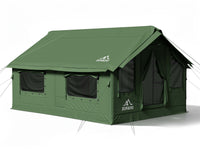
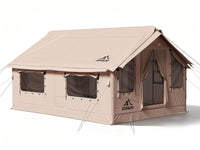
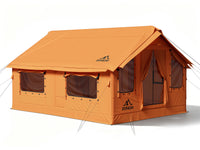
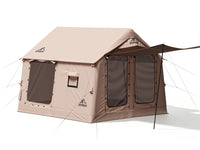
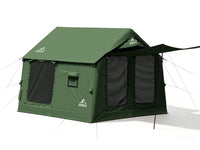
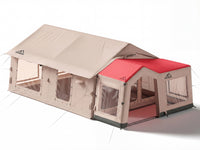
Take the ZONKOO Vega as an example. Its inflated Air Beams form the main supporting frame instead of relying on traditional tent poles that need to be inserted and connected one by one. For the user, the most noticeable difference is that once the tent is unfolded and inflated, the Air Beams form the frame while helping keep the 129 sq ft interior open and usable.
Vega
This is also why an inflatable tent does not need a blower running continuously like a bounce house.
During setup, you simply use a suitable pump to inflate the Air Beams to the pressure specified for that model. For example, the recommended pressure for ZONKOO inflatable tents is 5.5 PSI. Once the proper working pressure is reached, the valve is closed, and the air remains sealed inside the beam.
During normal use, the pump does not need to stay connected, and no continuous power supply is required.
An Air Beam is therefore better understood as a sealed supporting structure that is inflated, closed at the valve, and does not require continuous airflow, rather than an open inflatable structure that needs a constant supply of air to hold its shape.
Since It Is Still Inflatable, Can It Leak or Collapse?
This is another area where it is easy to go to the opposite extreme when thinking about inflatable tents.
The correct answer is not that an Air Beam can never leak.
Any outdoor product with valves, airtight components, and inflatable parts can lose pressure because of valve sealing issues, material damage, abrasion, punctures, or other problems. Air Beams are no exception.
The important point is that an Air Beam feeling softer than before does not necessarily mean it is leaking.
First, distinguish temperature-related changes from ongoing pressure loss. When outdoor temperatures change significantly, the pressure inside an Air Beam can change as well. A beam inflated during warmer daytime conditions may feel less firm after temperatures drop at night. As long as the beam still holds its normal shape and the tent structure shows no signs of a problem, that slight change alone does not indicate a leak.
Ongoing pressure loss is what deserves closer attention. If one Air Beam becomes noticeably softer over time, quickly loses pressure again after being reinflated, or continues to behave differently from the other beams, the valve, Air Beam, and potential leak points should be checked.
That is different from assuming an inflatable tent will automatically lose air overnight in the same way people often expect an air mattress to.
When something seems wrong, inspection usually focuses on the specific Air Beam and valve. Pressure loss in one beam does not mean you need to search the entire tent fabric for a leak. For ZONKOO users, continued pressure loss should first be checked according to the Air Beam structure and maintenance instructions for the specific model, including the valve and related airtight components, rather than simply adding more pressure.
The exact approach depends on the tent’s Air Beam design. If pressure continues to drop, follow the maintenance instructions for the specific model instead of repeatedly increasing the inflation pressure.
In other words, Air Beams can develop leaks, but that does not mean inflatable tents naturally behave like air mattresses that gradually lose their shape.
Further Reading: If your inflatable tent feels softer after setup, read Why Does an Inflatable Tent Feel Soft? Common Causes and Solutions to learn how to distinguish temperature and pressure changes, valve issues, and an actual leak.
Rethinking “Inflatable”
The name “Inflatable Tent” naturally draws attention to the word “inflatable,” which can make people think about past experiences with air mattresses, pool floats, or other soft inflatable products.
But with an inflatable tent, what matters more is how the air is being used within the structure.
- Air Mattress
Air is mainly used to provide softness, cushioning, and sleeping support.
- Inflatable SUP
It helps illustrate how air, at the proper pressure and within a constrained structure, can create noticeable rigidity.
- Tent Air Beam
Air is used within a purpose-built inflatable frame designed to support the tent.
So perhaps the simplest way to understand an inflatable tent is:
An inflatable tent uses air, but it is not designed to behave like an air mattress.
It is still an inflatable structure that requires proper inflation, inspection, and maintenance. But its reliability should be judged by the actual Air Beam design, specified pressure, and operating condition—not by applying past experiences with air mattresses directly to it.