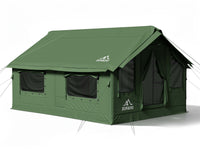
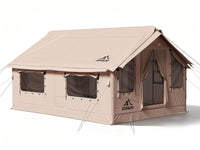
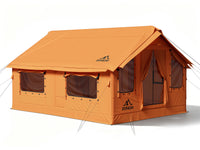
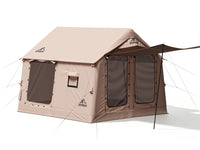
Inflatable tents can work well for overlanding, especially for vehicle-supported trips, group travel, or stays of several nights at the same campsite. Unlike backpacking, where minimizing weight is often a priority, overlanding places more emphasis on setup efficiency, interior space, vehicle storage, and campsite conditions. All of these factors affect how practical an inflatable tent will be.
However, a large ground-based inflatable tent is not the right fit for every overlanding trip. If you move camp every day, frequently stay on rocky or hard-packed ground, or already have limited storage space in your vehicle, there are more practical limitations to consider.
The real question is not simply whether an inflatable tent can be used for overlanding, but whether it fits the way you travel.
Why Are Inflatable Tents a Good Fit for Overlanding?
Because overlanding is vehicle-supported, tent weight does not have to be prioritized as heavily as it does for backpacking. If vehicle storage allows, you can choose a larger tent with more room for sleeping and spending time at camp.
Air-beam construction also makes camp setup more straightforward. Once you arrive, you can unfold the tent and inflate the main structure without assembling traditional poles and feeding them through sleeves. Stakes and guy lines still need to be secured properly, but the overall process involves fewer steps, which can be especially useful after a full day of driving.
Another advantage is that a ground-based inflatable tent is not tied to the vehicle. Once camp is set up, the tent can stay in place while you use the vehicle for exploring, resupply runs, or other activities. This can be especially convenient when you use one location as a temporary base camp for several nights.
Start With How Often You Move Camp
For overlanding, whether an inflatable tent is practical depends largely on how often you move camp. Inflation itself may be quick, but on a multi-stop trip, the bigger factor is how often you have to repeat the full setup and pack-down process.
If You Move Camp Every Day
At each new campsite, you need to unfold the tent, inflate it, and secure the stakes and guy lines. Before leaving the next morning, you also need to deflate it, fold it, and load it back into the vehicle. In dry weather, this is usually manageable, but after rain or in muddy or damp conditions, pack-down may also mean dealing with wet fabric and dirt.
If you move often, do not focus only on inflation time. Consider how easily the tent deflates, folds, and loads into the vehicle, as well as whether its packed size and weight are practical for repeated handling. The steps you repeat every day are what ultimately affect your travel pace.
If You Stay in One Place for a Few Nights
If you plan to stay at the same campsite for two or three nights, setup time becomes less important, while interior space and comfort matter more. Once the tent is set up, you do not need to reorganize it every day, and the extra room is useful for resting, changing clothes, and organizing gear.
This type of trip also makes better use of a ground-based inflatable tent as a fixed camp. The tent and some gear can stay in place while you use the vehicle during the day for exploring, resupply runs, or other activities, without packing up your sleeping area every time you drive somewhere.

Balance Interior Space With Vehicle Storage
Because overlanding is vehicle-supported, you can choose a roomier inflatable tent than you would for backpacking. But vehicle storage is still limited.
As tent size increases, packed size and weight usually increase as well. Your vehicle still needs room for water, food, a fridge, power supplies, tables and chairs, cookware, tools, recovery gear, and personal belongings.
The key question is not simply whether the tent fits in the vehicle, but whether enough space remains for the rest of your essential gear once the tent is packed.
Interior space should not be judged by stated capacity alone. Two people who mainly use the tent for sleeping may need relatively little room, while larger groups or travelers who keep luggage and other gear inside will need more space. If you plan to stay at the same campsite for several nights, standing room, gear organization, and space for everyday activities also become more important.
Before buying, compare the tent’s packed size, weight, and usable interior space when fully set up. The right size is not the largest tent your vehicle can carry, but one that meets your needs without taking up too much space needed for other essential gear.
Weather Conditions Also Affect Tent Choice
Overlanding routes can cross different regions, so the conditions your tent faces may change along the way. Weather suitability should not be judged by a single “waterproof” or “wind-resistant” label.
In open or windy areas, pay attention to the tent’s overall structure, guy lines, anchor points, and the manufacturer’s guidance on inflation pressure and weather conditions. Air beams replace traditional poles, but they do not eliminate the need to secure the tent properly with stakes and guy lines.
For rainy conditions, look at the waterproofing of the fabric, seams, tent floor, and door and window design. If you need to keep moving the next day, also consider whether a wet tent can be packed temporarily and then reopened to dry when conditions allow.
In hot weather, window area and high- and low-level ventilation are also important. A larger tent can still build up heat during the day if airflow is limited. If your route may include dry, dusty areas, check whether the main openings can be closed securely and adjusted easily.
The goal is not to find an inflatable tent that works in every kind of weather, but to make sure the tent is designed for the conditions you are most likely to encounter.

Campsite Ground Conditions Also Matter
Ground-based inflatable tents need enough space to be fully set up and rely on stakes and guy lines for secure anchoring. For overlanding, consider whether the campsites along your route typically offer relatively level ground, whether stakes can be secured properly, and whether sharp rocks or other debris could damage the tent floor.
If your route frequently includes gravel, hard-packed soil, or other surfaces where standard stakes are difficult to use, check whether suitable stakes or other permitted anchoring methods are available for those conditions. You will also need enough surrounding space to extend the guy lines properly.
Overlanding Also Requires a Reliable Inflation System
Long-distance overlanding can take you into remote areas, so setup efficiency is not the only factor to consider when choosing an inflatable tent. It is also important to understand how to inspect the air beams and valves, and what backup or repair options are available if something goes wrong.
Understand Air Beam and Valve Maintenance
Temperature changes between day and night can affect air-beam pressure, so a beam that feels slightly softer at night does not necessarily indicate a leak. Check whether the product clearly explains its normal inflation pressure, valve inspection, and basic maintenance requirements. This makes it easier to identify potential problems later.
Further reading: Why Does an Inflatable Tent Feel Soft? Common Causes and Solutions
Check Inflation Equipment and Backup Options
Different tents may require different pump connections and inflation pressures. Before choosing one, confirm which inflation equipment is compatible, how it is powered, and whether a manual pump can be used as a backup. On more remote routes, it is best not to rely entirely on a single piece of equipment.
Check Repair Options in Advance
Also check:
- Whether a repair kit suitable for the air-beam material is available
- Whether valves or air beams can be inspected or replaced individually
- Whether common replacement parts are readily available
The point is not to assume that every air-beam problem can be repaired in the field, but to know before choosing the tent whether there is a clear, practical way to deal with problems if they occur.
Inflatable Ground Tent vs. Rooftop Tent
Rooftop tents and ground-based inflatable tents can both work for overlanding, but they suit different travel styles.
|
Factor |
Inflatable Ground Tent |
Rooftop Tent |
|
Frequent campsite changes |
Requires setup and pack-down each time |
Some models set up and pack down quickly, but efficiency depends on the design |
|
Using the vehicle after setup |
Can remain at the campsite where campground rules allow |
Usually needs to be closed before driving |
|
Interior space |
Easier to choose a larger interior |
Limited by the roof platform and tent dimensions |
|
Vehicle requirements |
Requires enough interior cargo space |
Requires compatible roof racks and adequate roof load capacity |
|
Campsite requirements |
Needs enough level ground for setup and secure staking and guy lines |
Vehicle needs to be parked on relatively level ground |
|
Entry and exit |
Ground-level access |
Usually requires a ladder |
If you move camp every day, some quick-opening rooftop tents can reduce repeated setup and pack-down, but vehicle load limits, parking conditions, and ladder access still need to be considered.
If you stay in one place for several nights, want more interior space, and still need to use your vehicle during the day, a ground-based inflatable tent is better suited to creating an independent base camp.
Practical ZONKOO Inflatable Tent Options for Overlanding
The ZONKOO Orion and Vega can both work well for overlanding, but they offer different balances of interior space and ease of moving between campsites.
Both tents use 420D Oxford fabric with a PU5000 mm waterproof coating, a configuration well suited to vehicle-supported camping and multi-day stays. When properly pitched and fully secured, they are rated for winds up to 50 mph. Multiple ventilation openings help manage airflow, while the A/C port and stove jack provide connection points for compatible equipment when additional temperature control is needed.
Orion: A More Manageable Option for Small Groups
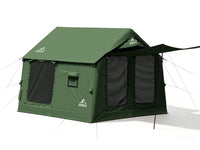
The Orion accommodates 2–4 people, offers 86 square feet of interior space, and can be set up in about 7 minutes.
For two people or a small group, it provides more usable space than a compact sleeping tent without requiring as much vehicle storage or campsite space as a larger base camp tent. If your route involves changing campsites but you still want more usable interior space, the Orion is a practical fit.
Orion
Vega: Better for Multi-Night Stays and a Larger Base Camp
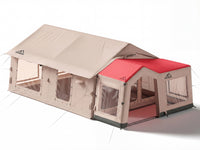
For families, small groups, or trips based at one campsite for several nights, the Vega offers 129 square feet of interior space and room for 2–6 people.
Its larger interior provides more room for sleeping, organizing gear, and everyday activities, making it well suited to serving as a base camp for several days. In return, the Vega requires more vehicle storage and campsite space, so it is a better fit for trips with fewer campsite changes and a greater emphasis on comfort at camp.
Vega
Choose the Right Tent for Your Overlanding Trip
The right overlanding tent is not necessarily the one that sets up fastest or offers the most interior space. What matters more is how well it matches your travel pace, available vehicle storage, group size, and the conditions you expect to encounter.
If you value an independent base camp and more interior space, a ground-based inflatable tent may be a better fit. If you move camp every day, the full setup, pack-down, and loading process should carry more weight in your decision.