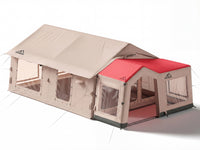
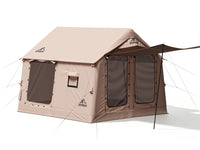
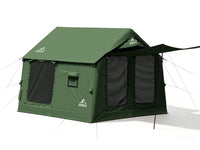
Many people feel a bit hesitant the first time they pack up a large tent. It’s not that they don’t want to leave—it’s that when they look at the tent spread out on the ground, a question naturally comes to mind: “Can something this big really be packed away smoothly?”
This feeling is especially common with large inflatable tents. Once they’re fully set up, their sheer size makes them feel overwhelming, and it’s easy to assume that packing them up must be physically demanding. But after doing it a few times, you gradually realize that large tents aren’t actually “hard to pack”—they just require the right approach.
What follows are inflatable tent packing tips that many people only figure out after repeated attempts.
Don’t Rush to Fold—Let the Space “Calm Down” First
A lot of the frustration during packing actually happens in the first few minutes. Air mattresses and folding chairs are still inside the tent, doors and windows are closed, air is trapped inside—and the moment you start, everything feels awkward and uncooperative.
Tip 1: Remove all hard items from inside the tent first
This isn’t about being tidy—it’s about letting the tent fully collapse. As long as there are hard objects inside, the tent will spring back no matter how much you press it down.
Tip 2: Open all doors and windows
This gives the air a way out. Folding a tent while it’s sealed is essentially fighting against trapped air.
Tip 3: Quickly shake off sand and leaves from the groundsheet
Many people skip this step, but once you start folding, sand getting stuck or leaves dragging along will easily cost you several extra minutes.
Once these three steps are done, you’ll clearly feel it:
The tent starts to “work with you.”
Packing an Inflatable Tent Always Starts with Deflation
If you’re used to traditional pole tents, it’s easy to instinctively treat packing as “setting up in reverse.” With inflatable tents, that mindset actually makes the process more tiring.
Tip 4: Open the main deflation valve first and let the structure collapse
Don’t open every valve at the beginning—that often makes things messier.
When you watch the tent slowly sink, you may suddenly realize:
You’re not dismantling it—you’re ending a session of use.
Tip 5: Start pressing from the end farthest from the valve
Many people crouch next to the valve and press for a long time, which takes a lot of effort. Instead, stand at the far end and gradually push the air toward the valve, like squeezing toothpaste. The tent will follow the direction of your force.
At that moment, you’ll realize that packing doesn’t have to be about brute strength—it’s about pushing in the right direction.
When Folding, Don’t Force Yourself to Chase Perfection
Many people get stuck on a mental hurdle the first time they pack a large tent:
“Am I folding this neatly enough?”
But camping isn’t an assembly line. With inflatable tents, what matters more than looking neat is avoiding twists and folding in the wrong direction.
Tip 6: Use the storage bag to set the folding width
Place the bag next to the tent and fold it toward it. The goal is simply to make it fit inside, not to fold it into a perfectly squared bundle.

Tip 7: Focus on aligning two lines
One is the edge of the groundsheet, and the other is the direction of the air tubes. Let the rest of the fabric stack naturally—this is completely fine.
Once you let go of the idea of “perfect folding,” the whole process becomes much faster.

What Really Determines Whether Packing Goes Smoothly Is the “Second Roll”
Many people feel relieved after the first roll, only to find the tent puffing back up when they try to put it into the bag—and the mood drops instantly.
But this doesn’t mean you did anything wrong.
Tip 8: The first roll is only for releasing air
Roll from the far end toward the valve, stop when you reach the valve, make sure it’s open, and press once more.
Tip 9: The second roll is what stabilizes the shape
Unroll it slightly, then roll it again. You’ll clearly feel that this time the tent becomes more “cooperative” and no longer springs back.

When Dealing with Wind or Wet Ground, Don’t Fight the Tent
Real camping is rarely ideal.
Tip 10: In windy conditions, leave two stakes in place to secure one corner
Don’t rush to pull everything out. Once the tent is stable, you’ll feel calmer too.
Tip 11: If the tent is wet, the goal is to take it away safely first
Shake off obvious water and wipe around key areas. Drying it later at home or at the next stop is far easier than struggling on the spot.
These aren’t shortcuts—they’re experience.
Packing Into the Bag: A Small Change in Approach Makes It Much Easier
If you always feel like you’re “stuffing” the tent into the bag, the process will inevitably feel exhausting.
Tip 12: Use a “slip-on” approach instead of forcing it in
Fully open the storage bag and start from one end of the rolled tent, slipping the bag over it. Move forward gradually while guiding the tent into the bag. This method takes less effort than pushing everything straight down and helps prevent the zipper from being overstressed.

When You Stop Feeling Tense, Packing Becomes Smooth
Packing a large inflatable tent has never been about brute strength.
Once you understand the structure—when to deflate, when to fold, and when to roll—the process turns into a stable, repeatable routine.
If you’re thinking about upgrading your camping space, or looking for a more relaxed option for family camping, it might be worth exploring different large tent structures 🏕️
On our ZONKOO tent page, you can compare sizes and use scenarios and find the one that truly matches your camping rhythm ✨