Women can safely camp alone with a dog, provided they choose the right campsite and prepare for both personal and pet-related risks. A dog can provide companionship and may notice unfamiliar sounds sooner, but it cannot replace personal safety judgment. You still need to check the campsite location, cell service, weather conditions, and exit routes in advance. Compared with regular solo camping, bringing a dog also means managing its leash, water, rest, and nighttime reactions, so the preparation needs to be more specific.
Your first trip does not need to involve a remote location or a difficult route. First, determine whether you and your dog can adapt to camping. Then prepare your gear, choose a tent and campsite, and plan how you will set up camp and handle nighttime arrangements. This can reduce last-minute stress and make the trip safer and more manageable.
Assess Whether You and Your Dog Are Ready to Camp
Before preparing for the trip, consider whether you can independently carry your gear, set up the tent, cook, move around at night, and evacuate in an emergency. If unfamiliar surroundings and nighttime sounds make you overly anxious, start with a short trip to a nearby, managed campground.
Your dog’s behavior also needs careful consideration. Watch how it responds to unfamiliar people, other dogs, nighttime sounds, and the scent of wildlife. If your dog tends to bark continuously, pull free from its leash, chase small animals, or cannot settle in a limited space, handling these situations alone may be difficult.
Before leaving, make sure your dog is up to date on vaccinations and parasite prevention, has any necessary medications, and is healthy enough for the trip. It should also respond reliably to basic commands such as “wait,” “come,” “stop,” and “leave it.” You can first spend a night in the backyard or at a nearby campground to see whether your dog is willing to enter the tent, whether it scratches at the door or mesh, and whether you can manage setup, feeding, and nighttime care on your own.
Prepare Your Gear and Safety Plan
Divide your gear into personal items, dog supplies, and emergency essentials. Personal items include sleep gear, a headlamp, backup lighting, warm layers or sun protection, a portable charger, offline maps, and a first-aid kit. Dog supplies include a properly fitted harness, a primary leash, a backup leash, dog food, water, a portable bowl, a dog bed, towels, waste bags, and regular medications.
Do not pack water based only on what your dog drinks during a normal walk. In hot weather, with increased activity, or at a campground without a reliable water source, both you and your dog will need extra water. The dog bed should provide basic protection from ground moisture. When camping in rain, mud, or sand, also bring supplies for cleaning your dog’s paws and coat.
Women camping alone should also set up a clear safety check-in plan in advance. Share the campground location, travel route, and expected return time with someone you trust, and agree on times to check in. Save the contact information for the campground office, nearby hospitals, and veterinarians, and download offline maps. Do not post your exact campsite location on public social media in real time, and you do not need to tell strangers how long you will be staying alone.

Choose the Right Tent for You and Your Dog
When choosing a tent for one person and one dog, do not base the size on a single camper. In addition to your sleeping pad, you need space for a dog bed, a backpack, a leash, towels, and an entry area for cleanup. If the tent is too small, the dog bed and gear can block the entrance. If it is too large, it can create extra work when you have to carry, set up, and pack the tent by yourself.
Compared with a traditional tent that requires you to connect and raise multiple poles, an inflatable tent uses air beams to support the structure, reducing the number of setup steps. When setting it up alone, there are fewer parts to hold and secure at the same time, making it easier to keep an eye on your dog.
When choosing inflatable camping tents for one person and one dog, do not look only at the listed capacity. You should also compare the floor area, tent weight, setup time, entrance size, and ventilation. The door should make it easy to lead your dog in and out, the doors and windows should close securely, and the interior should have separate areas for sleeping, your dog’s bed, and gear.
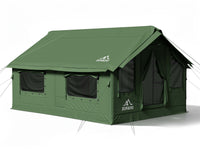
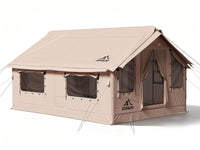
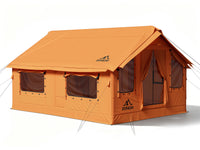
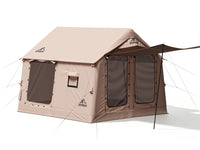
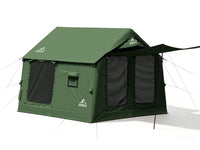
The ZONKOO Lyra is well suited to weekend or short camping trips for one person and one dog. It weighs about 29 pounds, takes about three minutes to inflate, and provides 65 square feet of floor space for a sleeping pad, dog bed, and essential gear. As a small inflatable tent that balances usable space with ease of handling, the Lyra does not add the same carrying, setup, and packing demands as a large family tent.
If you are bringing a large dog, carrying more gear, or planning a longer stay, you may want to consider a roomier tent. For solo camping, however, bigger is not always better. Being able to carry, set up, and pack the tent comfortably matters more.
Further Reading: To learn more about choosing the right tent size and arranging a dog bed and activity space, read What Type of Inflatable Tent Is Best for Camping With a Dog? for more detailed guidance on tent selection and interior layout.
Lyra
Choose a Safe, Pet-Friendly Campground
Once your gear and tent are ready, choose a campground that fits your trip. First, confirm that pets are allowed, whether dogs must remain leashed at all times, and whether they are permitted on nearby trails, beaches, and in public areas. Seeing “Pets Allowed” is not enough; you should also check where dogs are allowed and what other restrictions apply.
Women camping alone may want to prioritize campgrounds with clear rules, on-site staff, or regular patrols. Your campsite does not need to be directly beside other campers, but it should not be completely hidden by dense trees or terrain. A site within a reasonable distance of the restroom can make nighttime trips easier without placing you next to a busy public walkway.
Before booking, check cell service, water access, weather conditions, wildlife alerts, and evacuation routes. Plan to arrive before dark, so you have time to assess the area and request a different site if necessary. If the conditions do not match the online information or a campsite makes you feel uneasy, ask to move rather than forcing yourself to stay.
Check the Site and Set Up Your Space
When you arrive at the campground, do not unload all your gear or let go of the leash right away. First, observe the nearby campsites, people, and vehicles. Confirm the exit, cell service, and campground office location, then check the ground for broken glass, sharp branches, animal waste, anthills, or standing water.
If your vehicle can be parked near the campsite, position it so you can leave easily and keep the exit clear. Once the area looks safe, secure your dog and begin setting up the tent. Do not attach the leash to an air beam, guyline, or tent door, and keep stakes, table legs, and cooking equipment outside your dog’s leash range.
After the tent is set up, divide the interior into your sleeping area, your dog’s resting area, and an entry area for organizing gear. The dog bed should not block the exit or sit directly beside the tent door. Place the water bowl where it is less likely to be knocked over, and keep towels, leashes, and cleaning supplies near the entrance.
Keep your phone, headlamp, shoes, car keys, and backup leash in fixed, easy-to-reach places. The more organized the tent is, the easier it will be to get up at night, take your dog outside, or leave quickly.
Manage Safety During Your Stay
At the campground, do not let your dog roam freely just because it is usually well-behaved. Unfamiliar scents, other campers, and wildlife can change how it reacts. Keep the leash short enough to maintain control, and do not allow your dog to wander into other campsites, food areas, or public walkways.
When camping alone, you can be polite with nearby campers without sharing too much personal information. Try to finish collecting water, cooking, and organizing your campsite before dark. When leaving your site, carry your phone, a light, and other necessary items, and do not leave your dog alone in the tent.
During the day, provide water and rest as needed, check your dog’s paw pads for injuries, and avoid hot ground and unfamiliar plants. Before returning to the tent, clean your dog’s paws, coat, and belly, and check for ticks, grass seeds, and minor wounds.
Dog food, treats, used bowls, and other scented items can attract wildlife. Put the bowls away after feeding, and store food in your vehicle, a food locker, or an animal-resistant container according to campground rules. Do not store pet food, treats, used bowls, or other scented items inside the tent. Follow the campground’s food-storage rules at all times.
Nighttime Barking and Emergency Situations
If your dog suddenly starts barking at night, do not open the tent door right away or let it rush outside. First, keep the exit closed and attach the leash, then determine whether the sound is coming from other campers, small animals, something moving in the wind, or large wildlife nearby.
Stay inside the tent long enough to listen for the source of the sound, and use a light to check the area through the mesh or from another safe position. Do not open the tent door until you feel it is safe, and never approach a sound you cannot identify. If someone approaches the tent, you do not need to say you are alone. Keep your phone, car keys, shoes, and light within easy reach, and contact campground staff if necessary.
If your dog cannot settle down, or if there is large wildlife activity, suspicious people, or severe weather near the campground, move to a safer place. If the situation feels beyond your ability to assess, you can end the trip. Leaving early is not a failure. It is a responsible decision for both you and your dog.
Start With a Simple, Safe Trip
Solo camping with a dog is not only about completing an outdoor trip on your own. It is also about learning how to assess risk, organize your space, and care for both yourself and your dog in an unfamiliar environment. Being prepared does not eliminate every unexpected situation, but it helps you know what to do next when conditions change.
Your first trip can be simple. Choose a nearby campground with a familiar route and clear rules, and use a tent you can set up on your own. Start with one quiet night. As you and your dog become more comfortable with your outdoor routine, you may feel calmer and more confident about camping alone.