The key to setting up a family campsite is not making every piece of gear look perfectly organized. Start by deciding where the tent should go, then arrange the common area, cooking area, and gear so everyone can sleep, eat, relax, and move around the campsite without getting in each other’s way.
When two people are camping, leaving a chair or storage bin beside the tent may not cause much trouble. With a family of four, however, the tent, cooler, folding chairs, cookware, water, and personal items quickly start coming out of the car. Without a plan, the area around the tent entrance can become crowded fast, making it harder to eat, grab gear, or get in and out of the tent.
So family campsite setup is not just about whether the tent fits. It is more important to understand the campsite itself first, then arrange the space around how the family will actually use it.
What Should You Set Up First at a Family Campsite?
When you arrive at the campsite, do not unload the entire car right away.
Start by looking over the whole site. Many campgrounds already have a designated parking space, picnic table, and fire ring, and some also provide a defined tent pad. These fixed features cannot usually be moved and already shape much of the campsite layout.
Check where they are before deciding where to pitch the tent. If the site has a fixed fire ring, also consider the space around it so the tent entrance or the family’s main walking route does not pass directly through that area.
The tent should come first because its location will affect how you arrange the common area and cooking space. In addition to checking whether the ground is suitable, make sure there is enough room in front of the entrance and that the route between the tent, picnic table, and parking area feels easy to use.
Once the tent location is set, arrange the chairs and main gathering space, then set up the cooking area and other gear. This is easier than unloading every storage bin at once and reduces the need to move things around during setup.
This order is especially helpful when camping with kids. Before the campsite has a basic layout, spreading out the tent, chairs, storage bins, and cooking gear all at once only makes setup more chaotic. Set the most important areas first, then bring out the rest of the gear gradually.

What Areas Should a Family Campsite Include?
A family campsite does not need to be divided into strict sections, but it helps to have a few clear functional areas.
The first is the sleeping area, which includes the tent and the family’s sleeping gear. This space is mainly for sleeping, changing clothes, and storing personal items that need to stay clean and dry. Cookware, coolers, and large amounts of outdoor gear do not need to be kept inside.
Outside the tent is the common area. Chairs and tables can be grouped here so the family has a place to eat, talk, and relax during the day. For family camping, this area works much like the campsite’s living room.
The cooking and food area is for preparing meals and keeping food and drinking water organized. Many developed campgrounds already provide picnic tables, so there is no need to build a complicated outdoor kitchen just to make the campsite feel complete. The important thing is to keep cooking in one designated place instead of letting it gradually spread toward the tent entrance.
It also helps to create a simple entry and gear area. Shoes, backpacks, and lighting used throughout the day can stay near the entrance, while backup gear and storage bins that are not currently needed can remain in the car or be kept together somewhere that does not block a walkway. This keeps frequently used items easy to reach without crowding the tent entrance or common area.
These areas are not meant to divide the campsite into rigid blocks. The purpose is simply to give everything an appropriate place.
How Should You Arrange the Tent, Common Area, and Cooking Area?
Once you know which areas you need, what really affects the camping experience is how they are positioned in relation to one another.
The tent should primarily serve as the sleeping area rather than the center of every activity at the campsite. Leave enough open space in front of the entrance so no one has to move chairs before going inside at night or step over storage bins in the morning.
The common area can sit between the tent and the cooking area, or anywhere that is easy to reach from both. This gives the family a central place to spend time during the day, with easy access from the tent and a clear route for carrying food from the cooking area without passing through the sleeping space. If younger kids are camping with you, it also helps to place the common area where it can be easily seen from the tent and other main living areas.
The cooking area works better off to one side of the common area rather than in the middle of a main walkway. It should also be kept a safe distance from the tent, dry vegetation, and other flammable materials. Stoves should be used on a stable surface in a well-ventilated area, never inside the tent, vestibule, or another enclosed space. Food, trash, and scented items should be stored according to campground rules rather than left in the tent or unattended in the common area for long periods.
There is no need to follow a fixed left-to-right layout. What matters more is the relationship between sleeping, gathering, and cooking: no one should have to walk through the cooking area to reach the tent, cooking should not block the entrance, and the common area should still give the family a natural place to spend time together.
How Should You Adjust the Layout to Fit the Actual Campsite?
In real camping situations, you rarely arrive at a completely open campsite that can be arranged any way you want.
At some campsites, the picnic table is close to the parking area while the tent pad is on the other side. At others, the fire ring takes up the middle of the site. Trees, slopes, and surrounding vegetation can also limit where the tent can realistically go.
That is why the layout principles above should not be treated as a diagram that has to be copied exactly. A more practical approach is to work around the fixed features first, then arrange the gear that can be moved.
If the picnic table is already in a good spot for meals and relaxing, it can serve as the common area without adding another table near the tent just to create a separate zone. If there is some distance between the tent pad and the table, there is no need to fill that space with storage bins and chairs. Keeping the walkway clear is more useful.
How Can You Tell If a Family Campsite Is Set Up Well?
Once the campsite is mostly set up, there is no need to measure the distance between each area. Walking through the site is often more useful than comparing it with a standard layout.
Start by walking from the parking area to the tent. If you have to go around tables, step over chairs, or move storage bins along the way, the main walkway is probably blocked.
Then walk from the tent to the common area. There should be enough space around the tent entrance for people to get in and out easily, and people sitting nearby should not prevent anyone else from entering or leaving the tent.
Use the same approach with the cooking area. While one person is preparing dinner, can everyone else still sit and relax, get back to the tent, or grab something from the car without repeatedly walking through the cooking space? If so, the relationship between the different areas is working well.
Finally, check whether any single spot is being used for too many things. A campsite can feel crowded not because it is too small, but because the same space is being used as the tent entrance, seating area, and storage area for coolers and gear. Moving some of those items back to their proper areas can quickly make the campsite feel more open.

Choosing the Right Tent for Family Camping
A comfortable family campsite starts with a tent that fits both the number of people camping and how the space will actually be used.
When camping as a family, the tent holds more than just a few sleeping bags. Once the mattresses are laid out, there still needs to be room for clothes, personal items, and everyday movement. If kids are coming along, even more space may be needed. At the campsite, adults are also unloading gear, taking care of family members, and setting up other areas. If the tent still requires a lot of time to deal with complicated poles, the entire setup can quickly become hectic.
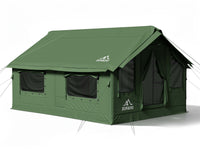
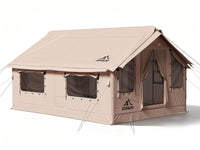
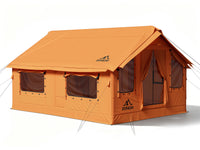
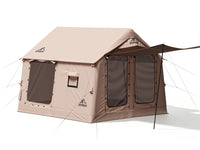
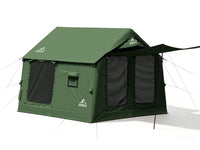
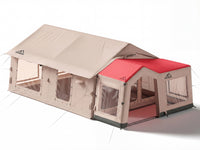
This is one reason inflatable tents are well suited to family camping. ZONKOO family inflatable tents use air beams to support the structure, reducing the need to connect and thread traditional tent poles and making setup easier.
For smaller families focused mainly on weekend camping, Orion is an easier-to-manage option among inflatable family tents. It sleeps 2–4 people and provides 86 sq ft of interior space. For a family of three or four, there is still room to move around after setting up mattresses and basic luggage, without an oversized tent taking up more campsite and storage space than the family needs.
For larger families, or those bringing more mattresses, clothing, and kids’ gear, Vega is a more suitable family inflatable tent for camping. It sleeps 2–6 people and provides 129 sq ft of interior space. The larger interior makes it easier to arrange sleeping areas and personal belongings, especially when the family is staying at the same campsite for several days.
Once the sleeping area is settled more quickly, the family can spend more time setting up the rest of the campsite and enjoying the outdoors.
Further Reading: How to Choose an Inflatable Tent? A Comparison Guide to 5 ZONKOO Camping Tents.
Make Family Camping Easier From the Start
There is no single campsite layout that works for every campground. Start by looking at the site itself, then arrange the space around how the family will actually use it. This makes the entire camping experience run more smoothly.
A truly comfortable campsite is one where the family can settle in without constantly moving things around or feeling like something is always in the way. When the space works well, camping naturally feels easier.