Choosing tent stakes starts with the ground at your campsite. Standard stakes work well in ordinary soil, while hard ground and gravel call for better penetration and greater strength. In soft soil, sand, or snow, depth and surface area become more important.
The same set of stakes may hold securely in grass but be difficult to drive into hard-packed ground. In soft soil or sand, even a deeply driven stake can gradually work loose under tension. That is why simply switching to a thicker or stronger stake will not solve every anchoring problem.
Instead of looking for one all-purpose stake, choose based on the ground conditions, stake type, and your tent’s anchoring needs, so you arrive with the right stakes for the campsite.
1. Why Don’t Stock Tent Stakes Always Work?
The stakes included with many tents work well in ordinary soil but may be difficult to drive, prone to loosening, or more likely to bend on different types of ground. This does not necessarily mean the stakes are poor quality. Stock tent stakes are usually designed as general-purpose options and cannot perform equally well in every condition.
A few common signs can help show whether the stakes are suitable for the ground:
- Difficult to drive: The ground may be too hard, or there may be rocks below the surface.
- Loosen easily after setup: The soil may be too soft, or the stakes may not provide enough depth or surface area to resist pullout.
- Bend while being driven: The stakes may not be strong enough, or they may be taking too much impact or sideways force in hard ground.
If the original stakes hold your tent securely at the campsites you normally visit, there is no need to replace all of them. If you regularly camp on hard ground, sand, snow, or other challenging surfaces, add stakes suited to those conditions instead.

2. How Should You Choose Tent Stakes for Different Ground Types?
What a tent stake needs to do comes down to two things: whether it can be driven into the ground and whether it can stay secure once it is in place.
|
Ground Type |
Main Issue |
What to Prioritize |
Common Options |
|
Grass and ordinary soil |
No major limitations |
Versatility |
Y stakes, V stakes |
|
Soft soil |
Stakes can loosen or pull out |
Length, surface area |
Longer Y or V stakes |
|
Hard or compacted ground |
Difficult to drive, may bend |
Penetration, strength |
Nail / Pin stakes, sturdy Y stakes |
|
Gravel |
Stakes may hit rocks |
Narrow, strong design |
Nail stakes, narrow pointed stakes |
|
Sand |
Thin stakes pull out easily |
Larger surface area |
Wide sand stakes |
|
Snow |
Standard stakes hold poorly in loose snow |
Large surface area, buried anchoring |
Wide snow stakes, buried anchors |
Soft Soil: Consider Both Length and Surface Area
Tent stakes are easy to drive into soft soil, but they are also easier to pull out. Extra length can help a stake reach deeper soil, but it still needs enough surface area to resist pullout. Simply making a thin stake longer does not necessarily provide reliable anchoring.
Hard Ground and Gravel Require Different Priorities
Hard ground puts more emphasis on penetration and stake strength. Gravel also requires a strong stake, but the stake must be narrow enough to work between rocks. When the ground contains a lot of gravel, a narrower design is generally easier to place than a wide one.
Sand: Surface Area Matters More Than Length Alone
Loose sand provides little resistance for a narrow stake, even when it is driven fairly deep. Sand stakes therefore need a larger surface area to hold effectively. Wide stakes or suitable anchors buried horizontally in the sand are commonly used.
Snow: Start With the Condition of the Snow
Loose, fresh snow requires a larger surface area, so wide snow stakes or horizontally buried anchors can work better. Packed or frozen snow behaves differently, so the stake and anchoring method should be adjusted to the actual conditions.

3. What Is the Difference Between Y, V, Nail, and Hook Tent Stakes?
The shape of a tent stake mainly affects two things: how easily it goes into the ground and how much holding power it provides once installed.
|
Type |
Design |
Best Suited For |
Main Limitation |
|
Y stake |
Three-fin profile with more surface area |
Ordinary soil, moderately soft soil |
Harder to place in rocky ground |
|
V stake |
Wide cross-section, simple design |
Ordinary soil, soft soil |
Thinner versions may bend more easily |
|
Nail / Pin stake |
Narrow profile with strong penetration |
Hard ground, compacted soil, gravel |
Limited holding power in soft soil |
|
Shepherd's Hook |
Thin rod design, lightweight |
Ordinary soil, lightweight camping |
Less effective in soft or rocky ground |
|
Sand / Snow stake |
Wide profile with a large surface area |
Sand, loose snow |
Usually larger and heavier |
Y Stakes vs. V Stakes
Both designs use a wider profile to create more holding power in the soil, and both can work well in ordinary ground. Y stakes are generally more versatile because of their three-fin design. V stakes have a simpler profile, but their strength depends more heavily on material thickness and overall construction. Neither design is automatically better in every situation.
Penetration and Holding Power Require a Trade-Off
Wider stakes engage more soil and resist pulling forces more effectively, but they can also be harder to drive into hard or rocky ground. Narrow Nail or Pin stakes penetrate firm ground more easily but provide less holding power in soft soil.
For that reason, a wider stake is not always better, and a thinner stake is not better simply because it is easier to drive. The key is whether the ground calls for better penetration or more holding power.

4. What Else Matters Once You’ve Chosen a Stake Type?
Once you know which type of stake suits the ground, consider the material, length, and number of stakes required by the tent. Material affects weight, strength, and durability, while length affects how deeply the stake can reach into the ground. For larger tents, it is also important to use the tent’s anchor points and guylines as intended.
What Is the Difference Between Steel, Aluminum, and Titanium Stakes?
|
Material |
Main Characteristics |
Best Suited For |
What to Consider |
|
Steel |
Strong, impact-resistant, heavy |
Car camping, hard ground, large tents, or canopies |
Weight adds up when carrying multiple stakes |
|
Aluminum |
Lightweight, with a good balance of weight and strength |
General camping, balancing weight and practicality |
Strength varies by alloy, profile, and thickness |
|
Titanium |
High strength-to-weight ratio, well suited to lightweight setups |
Backpacking, weight-conscious setups |
Usually more expensive, thin designs provide less holding power in soft soil |
Are Longer Tent Stakes Always Better?
No. Longer stakes can reach deeper into the ground, but that does not mean they will hold better in every condition.
Consider three factors when choosing stake length:
- Soil depth: If the soft surface layer is deep, a longer stake has a better chance of reaching firmer soil below.
- How far the stake can actually be driven: In gravel or shallow soil, a longer stake may hit rocks before reaching its full depth.
- Anchoring needs: Large tents, canopies, and main anchor points may require greater holding power, so stake size should follow the tent manufacturer’s setup guidance.
What matters is how much stable soil the stake can actually reach, not simply how long the stake is.
For Large Tents, Stake Count Matters Too
Tent stability does not depend on a single stake alone. For larger family tents, the number and placement of anchor points also affect how wind loads are distributed into the ground.
More anchor points allow different parts of the tent to be secured with stakes and guylines, reducing the amount of force concentrated on only a few points. But stake count alone does not determine how secure a tent will be. What matters more is whether the anchor points match the tent structure and whether they are all used correctly during setup.
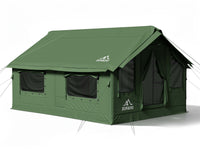
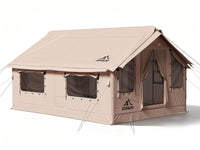
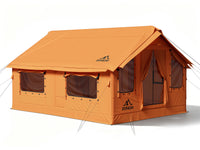
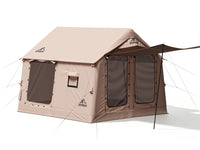
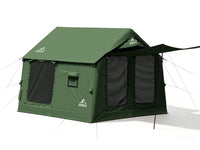
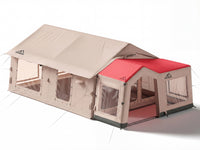
For example, ZONKOO inflatable tents come with different numbers of stakes depending on their size and structure. The Orion includes 28 stakes, while the larger Draco Plus, which also features a separate gazebo, includes 43. The stakes and guylines work together across multiple anchor points. When properly set up and fully staked and guyed out, ZONKOO inflatable tents can withstand winds of up to 50 mph.
5. How to Use Tent Stakes Correctly
Choose the Stake Location First
Avoid obvious rocks, large roots, and excessively loose ground. If a stake hits solid resistance after only a short distance, move to a different spot instead of continuing to hammer it. Forcing the stake can cause it to bend or become damaged.
Drive Stakes In With a Tent Mallet
Set the stake in the intended direction, then drive it in gradually with a tent mallet. Avoid striking it from the side or forcing it into the ground with your foot. Drive the stake as fully as possible into stable soil, leaving only enough exposed to attach the tent loop or guyline.
If a stake cannot be driven in far enough, try a different location first. If repeated attempts still fail, switch to a stake better suited to the ground.
Set the Angle Based on the Anchor Point and Guyline Direction
There is no single stake angle that works for every setup. Tent loops, guylines, standard stakes, and sand or snow anchors do not all handle force in the same way.
Follow the instructions for the tent and stakes to determine the correct direction rather than defaulting to a fixed 45-degree angle.
Guylines should be tensioned enough to stabilize the tent without being overstretched. Too little tension will not provide effective support, while too much can place unnecessary strain on the tent structure and anchor points.
Whenever possible, keep stakes and guylines away from the tent entrance and main walkways. If they cannot be avoided, brightly colored or reflective guylines and markers can help reduce nighttime tripping hazards.
Recheck the Setup After Wind or Rain
After strong winds, prolonged rain, or when the ground has softened, check:
- whether any stakes have pulled upward or shifted noticeably;
- whether the soil around the stakes has loosened;
- whether any guylines have become noticeably slack;
- whether tension remains even across the tent’s anchor points.
If a stake hole has already loosened, move the stake into stable soil nearby instead of placing it back into the same hole.
Further Reading: How to Set Up a Large Inflatable Tent?
6. The Right Stakes Are Only Part of a Secure Setup
Tent stakes are only one part of a tent’s anchoring system. A stable setup depends on suitable stakes, proper placement, and correct use of the guylines and anchor points.
Before heading out, check the ground conditions at your campsite and make sure the stakes, guylines, and anchor points are complete. This can help prevent problems such as stakes that will not go into the ground, stakes that will not hold securely, or too few stakes when it is time to set up. For family camping, preparing these details in advance helps create a stable, reliable campsite.