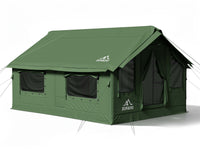
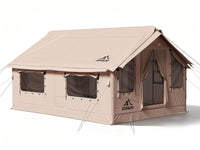
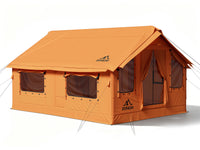
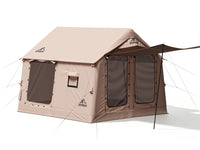
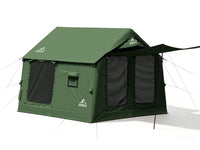
A cabin tent is a good fit for families who mainly go car camping and value standing room and a practical interior layout, but not every family camping trip calls for one. Straighter sidewalls and greater interior height allow beds, luggage, and storage bins to sit closer to the walls, leaving more open space for moving around and everyday activities.
If a family brings air mattresses, storage bins, and plenty of gear and plans to stay at the same campsite for several nights, the benefits of that extra usable space become more noticeable. For short overnight trips, smaller campsites, or trips that involve moving camp frequently, however, a more compact tent may be easier to manage.
For that reason, choosing a cabin tent should not be based on its stated sleeping capacity alone. Bed size, gear volume, campsite conditions, and transportation all need to be considered.
What Is a Cabin Tent?
A cabin tent generally refers to a camping tent with relatively straight sidewalls, generous interior height, and a more box-like overall shape. Once set up, the interior feels more like a small room, which is where the name comes from.
However, cabin tents are not defined by a single, strict technical standard. Designs vary by brand. Some have flatter roofs, while others retain more of a curve. What generally makes a tent cabin-style is its emphasis on usable standing room, greater height near the walls, and a more room-like interior layout.
A cabin tent is also not defined by a specific support system. Traditional models may use metal or fiberglass poles, while modern designs may use Air Beams or other inflatable structures.
In other words, cabin-style mainly describes the tent’s shape and interior layout once it is set up, rather than the type or material of its supports.
Why Are Cabin Tents Good for Family Camping?
The main advantage of a cabin tent for family camping is not simply having more floor space, but being able to use more of that space effectively.
Compared with tents whose walls slope inward toward the roof, cabin tents usually retain more height near the edges. Thicker air mattresses, camping cots, or storage bins can sit closer to the walls without losing as much usable space above them, making it easier to keep the center of the tent open for moving around and everyday activities.
The difference becomes more noticeable as the number of campers increases. A family tent needs to hold more than sleeping gear. Backpacks, shoes, clothing, and other frequently used items also need a place to go. If everything ends up piled beside the beds or near the entrance, a tent can quickly feel crowded even when its stated sleeping capacity is high enough.
A taller interior with a broader standing area also makes it easier for adults to change clothes, make the beds, and reach gear. For families staying at the same campsite for several nights, these everyday differences can matter more than simply having a little extra sleeping space.
When a family needs to fit sleeping, storage, and everyday activities into the same space, the advantages of a cabin tent become most noticeable.

What Are the Trade-Offs of a Cabin Tent?
A cabin tent provides more usable interior space, but that space also comes with greater demands on campsite size, transportation, and setup.
The first consideration is footprint. A large cabin tent needs enough room not only for the tent itself but also for doors, guy lines, and the necessary space around it. If a campground uses fixed tent pads, or if trees, rocks, or other obstacles surround the site, a larger tent may be difficult to set up properly.
Packed size and transportation also matter. More fabric and a larger support structure usually mean a bulkier packed tent, which makes cabin tents better suited to car camping where a vehicle can get close to the campsite. If gear needs to be carried a long distance, or if camp is moved frequently during a trip, the extra size and weight become more noticeable.
If car camping is your main style of camping, you can read Why Are Inflatable Tents Well Suited for Car Camping? to learn how tent space, transportation, and setup affect the overall car camping experience.
Taller, straighter walls also generally create more surface area for wind to push against. However, a tent’s actual wind performance cannot be judged by shape alone. It also depends on the overall structure, stakes, guy lines, setup, and site conditions. At open or windy campsites, site selection becomes more important, and the tent should be fully secured according to the manufacturer’s instructions.
- A cabin tent may be a better fit for: family or group car camping, trips with more gear, larger beds, and stays of several nights at the same campsite.
- A more compact tent may be a better fit for: one or two people on short overnight trips, smaller campsites, frequent camp changes, or trips that require carrying gear longer distances.
What Is the Difference Between a Cabin Tent and a Dome Tent?
A dome tent generally has an arched roof with sidewalls that slope inward, so most of the interior height is concentrated near the center. Dome tents and cabin tents are both commonly used for family camping, but they make use of interior space differently. Cabin tents emphasize wall height and standing room, while dome tents generally have a more compact overall shape.
|
Comparison |
Cabin Tent |
Dome Tent |
|
Sidewalls |
More upright |
Usually slope inward toward the top |
|
Usable space near the walls |
More |
Less |
|
Standing area |
Usually extends across more of the interior |
Height is more concentrated near the center |
|
Tall air mattresses or camping cots |
Easier to use near the walls |
More affected by sloping walls |
|
Campsite and packed size |
Larger models usually require more space |
Compact options are easier to find |
|
Wind profile |
Taller walls generally create more surface area exposed to wind |
A lower, rounded profile generally has less surface area exposed to wind |
For two people carrying only a small amount of gear on a short overnight trip, the sloping walls of a dome tent may not make much difference, and it is often easier to find a smaller model.
But when four people need to fit mattresses, luggage, clothing, and everyday gear inside the same tent, usable space near the walls can directly affect how crowded the interior feels. Because a cabin tent retains more height along the sides, that space is usually easier to organize.
Neither style is better in every situation. If standing room, bed layout, and comfort over several nights matter more, a cabin tent may be the better fit. If compact size, portability, and a lower overall profile matter more, a dome tent may be more suitable.
How Do You Choose the Right Cabin Tent?
When choosing a cabin tent, the first step is not to look at the stated sleeping capacity, but to think about what will actually go inside.
If you plan to use air mattresses or camping cots, check their actual length and width and compare those dimensions with the tent floor. Once the beds are in place, there should still be enough room for an entry path, luggage, and basic storage rather than having the sleeping setup fill the entire tent.
Next, consider how the family will actually use the space.
If the tent is mainly for sleeping, one open interior may be enough. If more people are camping together, family members have different schedules, or the trip lasts several nights, removable dividers, multiple entrances, or additional living space can make sleeping, changing, and everyday activities easier to manage.
Campsite size also matters. A large cabin tent may feel more comfortable inside, but the tent body, doors, and guy lines all require room. If you often stay at campgrounds with fixed tent pads, checking the site dimensions in advance is more important than simply choosing a larger tent.
Finally, consider transportation and setup. If you mainly go car camping and usually stay at the same campsite for several nights, space and layout can take higher priority. If you move camp frequently during a trip, packed size and ease of setup should also be considered.
The right cabin tent is not necessarily the largest one. It is the one that fits the beds, gear, family size, campsite, and the way you travel.
How Does ZONKOO Combine Cabin-Style Space With Air Beam Support?
Cabin-style refers to the tent’s shape and interior space once set up, while Air Beam describes the main support system. Several ZONKOO family inflatable tents use greater interior height, open layouts, and no center pole occupying the main living area to create the kind of usable space associated with cabin-style tents.
Different families need more than just different amounts of space. What matters is how that space can be used.
|
Family Camping Need |
Model |
Usable Space |
Main Space Advantage |
|
2–4 people who want to keep the campsite footprint manageable |
Orion |
86 sq ft |
Compact sleeping and activity space |
|
More room for beds and gear |
Vega |
129 sq ft |
More space for storage and daily activities |
|
Group camping with a need for separate interior areas |
Draco |
183 sq ft |
Removable divider for flexible zoning |
|
Separate shared activities from the sleeping area |
Draco Plus |
252 sq ft |
Added Gazebo space outside the main tent |
Orion and Vega serve families that need different amounts of open interior space. Orion offers 86 sq ft of space and a 6'11" interior height, making it better suited to families of 2–4 who want to keep the overall campsite footprint more manageable. Vega expands that to 129 sq ft with a 7'1" interior height, leaving more room for beds, luggage, and everyday activities.
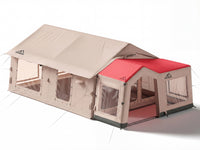
As group size and the length of the stay increase, flexible zoning becomes more important. Draco provides 183 sq ft of interior space and uses a removable divider to create separate areas, helping reduce disruption when several people share the same space. Draco Plus builds on that layout with an attached Gazebo, moving dining and some everyday activities out of the main sleeping area and making it better suited to larger groups or families staying for several nights.
From Orion to Draco Plus, the difference is not only how much space each tent provides, but what that space can do: from compact family sleeping space to more room for everyday activities, then to divided interiors and a separate shared area.